


Your shopping cart is empty!
Watermelon "Sugar Delicata" F1
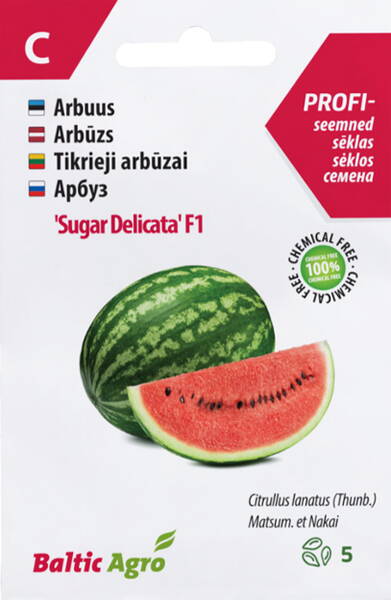
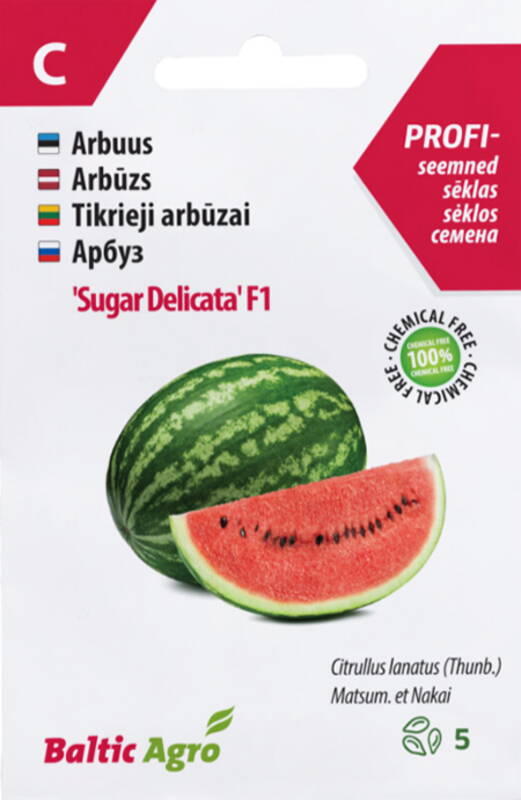
Watermelon "Sugar Delicata" F1.
Early (70-80 days) hybrid variety with vigorous growth. The fruit is broadly elliptical, striped, with a medium-thick rind. Fruit weight reaches 9-12 kg. The flesh is dark red and very sweet. The hybrid is distinguished by excellent transportability and long shelf life after harvesting (45-65 days).
Agrotechnics and planting site.
Watermelon prefers light, air- and water-permeable soils (sandy and sandy loam). Excessively moist and heavy soils are not suitable. The site should be slightly elevated, maximally illuminated and well-warmed, protected from cold winds. Observe crop rotation: watermelons are planted in the same place no earlier than after 4 years.
Sowing and cultivation.
Can be grown both in open ground and in greenhouses.
* Sowing seeds: tentatively in May, when the soil warms up to a depth of 8-10 cm to +15+16°C. Before sowing, it is recommended to treat the seeds in a solution of potassium permanganate, then rinse with clean water.
* Seedling method: seedlings are planted in the ground when the threat of recurrent frost has passed, at the age of 3-4 true leaves.
* Planting scheme: in open ground — 140x100 cm, in greenhouses — 70x70 cm (with mandatory tying to a trellis; fruits are suspended in nets).
Care.
As the plant grows, it is formed into one stem, removing all side shoots. 2-3 ovaries are left on one plant, after which the top is pinched (the remaining ovaries are removed so that the fruits have time to ripen).
Further care consists of moderate watering, loosening the soil, fertilizing, and sprinkling the vines with earth (in open ground) to prevent them from being turned over by the wind.
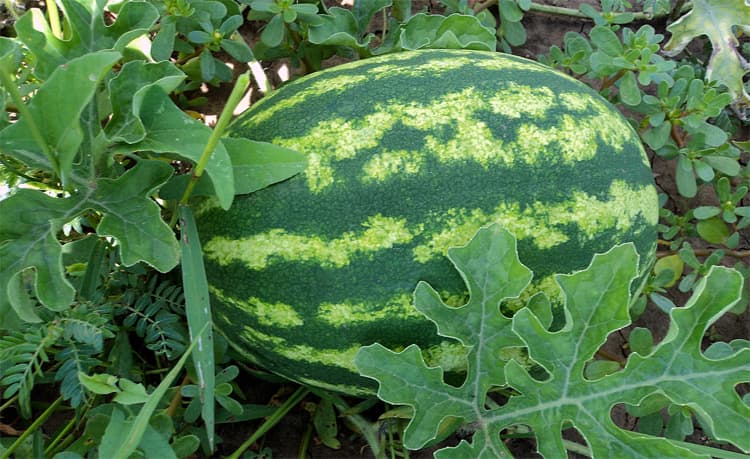
Early (70-80 days) hybrid variety with vigorous growth. The fruit is broadly elliptical, striped, with a medium-thick rind. Fruit weight reaches 9-12 kg. The flesh is dark red and very sweet. The hybrid is distinguished by excellent transportability and long shelf life after harvesting (45-65 days).
Agrotechnics and planting site.
Watermelon prefers light, air- and water-permeable soils (sandy and sandy loam). Excessively moist and heavy soils are not suitable. The site should be slightly elevated, maximally illuminated and well-warmed, protected from cold winds. Observe crop rotation: watermelons are planted in the same place no earlier than after 4 years.
Sowing and cultivation.
Can be grown both in open ground and in greenhouses.
* Sowing seeds: tentatively in May, when the soil warms up to a depth of 8-10 cm to +15+16°C. Before sowing, it is recommended to treat the seeds in a solution of potassium permanganate, then rinse with clean water.
* Seedling method: seedlings are planted in the ground when the threat of recurrent frost has passed, at the age of 3-4 true leaves.
* Planting scheme: in open ground — 140x100 cm, in greenhouses — 70x70 cm (with mandatory tying to a trellis; fruits are suspended in nets).
Care.
As the plant grows, it is formed into one stem, removing all side shoots. 2-3 ovaries are left on one plant, after which the top is pinched (the remaining ovaries are removed so that the fruits have time to ripen).
Further care consists of moderate watering, loosening the soil, fertilizing, and sprinkling the vines with earth (in open ground) to prevent them from being turned over by the wind.
* There is hardly a person who would say that they do not like watermelons...
This giant berry (botanically speaking) appeals to everyone. In the season when the harvest ripens, many even use a watermelon diet to cleanse the kidneys and urinary tract, which is indeed effective. But few people know that this fruit possesses other healing properties. For example, it contains iron, — therefore, it helps with anemia. The content of easily digestible sugars makes it a source of quick energy. For the treatment of liver and gallbladder diseases, as well as atherosclerosis, hypertension, gout, gastritis, constipation, arrhythmia, obesity, and various intoxications, it is recommended to include fresh watermelon pulp in the daily diet.
For general body cleansing, in the absence of contraindications, watermelon fasting is used, when for 3-4 days only watermelons and rye bread are eaten. Intensive urine output during these days flushes the kidneys and urinary tract, carrying out grains of sand and small stones.
Not only the pulp of the watermelon is healing, but also the seeds and the rind. They can be prepared for future use and used for the same diseases as the pulp, in the form of decoctions and infusions. Thus, for gastritis, 100 g of dry rinds should be poured with 0.5 l of boiling water and infused until completely cooled. It is better to do this in a thermos. Adults with an average weight of 70-75 kg are recommended to take 100-125 ml of the infusion 4-6 times a day. Reduce the dosage for children in proportion to the child's weight.
For gallstone disease and to cleanse the bile ducts, pour 1 litre of boiling water over 150-170 g of dry rinds, put on low heat and boil for 25-30 minutes. Take 200 ml of the decoction before meals 3-5 times a day.
Consumption of watermelon pulp in large quantities is contraindicated in cases of renal failure, exacerbation of gastric ulcers, and duodenal ulcers.